

Product safety
Manufacturer
Davids Grinbergs, Northwoofs®
Ainažu iela 25 k-3 -2
LV-2160 Saulkrasti
Latvia
woof@northwoofs.com
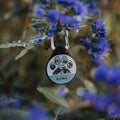
ID tags and QuickRing™
Fitting
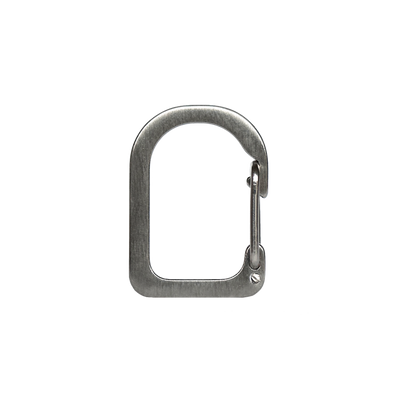
- Attach the tag to the collar's tag holder or D-ring and check that the carabiner or QuickRing is fully closed.
- Never attach a leash to the tag, its carabiner or a QuickRing. They are not made to hold your dog.
In use
- Not a toy. Don't let your dog chew the tag; swallowed pieces can be dangerous.
- Take the collar and tag off when your dog is in a crate, left alone or playing roughly with other dogs, so the tag can't catch on anything.
- Small parts: keep away from children under 3 years.
Checks and care
- Check the tag, its loop and the carabiner or QuickRing regularly. Replace them if the silicone is cracked or the clip no longer closes by itself.
- Keep the engraved contact details up to date. An outdated phone number makes the tag useless.
Collars
Fitting
- Pick the size by measuring your dog's neck, and adjust the collar so it sits comfortably: snug enough that your dog can't slip out, but never so tight that it presses or chokes.
- Check the fit regularly, and every few weeks in growing puppies.
- Close the quick-release buckle until it clicks, and give it a tug to check it holds.
Limited QuickSlip™ only
- Set the slip so that, pulled fully closed, the collar still sits snug but never tighter than your dog's neck. It must not choke.
- Use it on walks only, and take it off at home, in the crate and in the car.
- Not for training by jerking the leash.
In use
- Take the collar off when your dog is in a crate, left alone or playing roughly with other dogs. It can catch and choke.
- Never tie your dog up by the collar, and don't use it as a car restraint.
- Clip the leash to the metal ring, never to the paracord tag holder.
- For dogs that pull hard, a harness is gentler on the neck.
Checks and care
- Check the screws, holes, buckle, ring and paracord before every walk. Tighten a loose screw, and stop using the collar if anything is torn, bent or broken.
Leashes, HandleMe™ and DoubleTrouble™
Fitting
- Clip the leash to the metal ring of the collar or harness, never to the ID tag, the tag holder or a QuickRing, and check the carabiner is locked.
- Close the quick-release buckle until it clicks before every walk.
Hands-free use
- Wear it around your hips or across your body only with a dog that walks calmly on the leash. A sudden pull can knock you over.
- Never put the leash around your neck.
- Make sure you can open the quick-release buckle with one hand in an emergency.
- Not for cycling, skating or pulling sports.
In use
- Don't wrap the leash around your hand or fingers. A sudden pull can injure them.
- Use the short traffic handle to keep your dog close near roads, people and other animals.
- Never tie your dog up with the leash or leave it attached when your dog is alone.
- Not for climbing, towing or as a seat belt in the car.
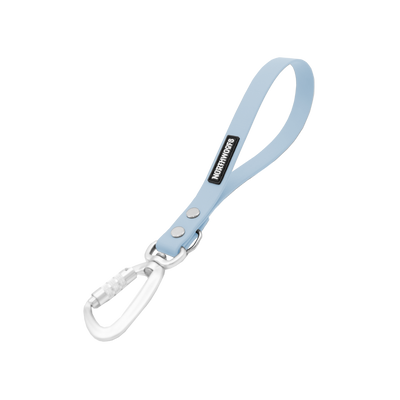
HandleMe™ leash tab
- Don't let your dog run free with it attached; it can catch on branches or fences.
DoubleTrouble™ adapter
- Use it only with two dogs that walk well together and are of similar size and strength.
- Check both carabiners and the connection to the leash before every walk.
- With third-party leashes, use the adapter ring and check that the connection is secure.
- Never leave the dogs coupled together when you are not holding the leash.
Checks and care
- Check the leash, screws, buckle and carabiners before every walk. Tighten a loose screw. Replace the leash if it is cut or worn, or if a carabiner no longer locks by itself.
- Rinse off salt water and sand after use and let the carabiners dry, so the locking spring keeps working.
All dog gear
All dog gear
- For dogs only. Use the product only for what it is made for.
- Check it before every walk for cracks, cuts, wear or loose parts, and stop using it if anything is damaged.
- Don't leave your dog alone with it, and keep the packaging away from dogs and children. Chewed-off pieces can be swallowed.
- Keep away from open fire and strong heat.
- Clean with water and mild soap only. No solvents, bleach or scouring pads.
- Replace it as soon as it shows wear. Don't repair or modify it yourself.
Tumblers
Hot drinks
- Hot drinks can scald. Close the lid firmly while the tumbler stands upright, and drink slowly.
- Keep it away from young children when it holds a hot drink. The lid seal is a small part.
- If the outside gets warm with a hot drink inside, the insulation is damaged. Stop using it.
What not to do
- No carbonated drinks or dry ice. Pressure can push the lid off.
- Not for the microwave, oven, stove or freezer.
- Don't leave drinks, especially milk, juice or soup, inside for a long time. They can spoil and build up pressure.
Care
- We don't recommend the dishwasher: it can shorten the life of the coating, the engraving and the lid seal. Wash it by hand with warm water and mild soap, and let it dry open.
- Don't use bleach, steel wool or abrasive cleaners; they damage the coating and the engraving.
- Stop using it if the lid seal is torn or missing, or if it rattles inside after a fall.